


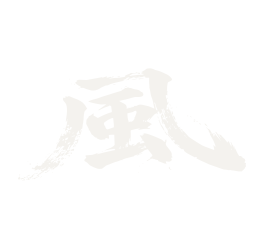
Wind
Wind, kaze, runs all through Japanese art and language. It has its own god, a name for almost every wind of the year, and it turns up inside everyday words for landscape, elegance and style.
風 (kaze): wind. In compound words it is read fū.
Look closely at 風 and some see a bird inside it: its oldest form was drawn from a great bird, the phoenix, whose wings were thought to stir the air. The insect inside the modern character came later. The bird was the wind first.
Fūjin, the wind god, carries the winds of the world in a great bag slung over his shoulders, and releases them as he flies. He is usually paired with Raijin, the thunder god, who beats a ring of drums. The best-known image of the two is a pair of folding screens painted by Tawaraya Sōtatsu in the seventeenth century, a national treasure of Japan: Fūjin green, Raijin white, both racing across a field of gold.
Japanese names its winds by season and by what they do. Kogarashi, the tree-witherer, is the first cold wind of early winter, stripping the last leaves from the branches. Haru ichiban, spring’s number one, is the first strong southern wind of the year. Nowaki, the field-divider, is the storm wind of autumn that parts the tall grasses. Poets have hundreds more.
風 sits inside many words that have little to do with weather. Fūkei, 風景, is a landscape: wind and view. Fūryū, 風流, is refined taste and elegance. In summer, fūrin, 風鈴, wind bells, hang from the eaves so the smallest breeze can be heard.
The Kaze Tee draws lines of wind carrying raven feathers across the back, with 風 set beneath it: feathers loosed from the same raven that runs through the line.

We use cookies to run the store and understand how the site is used.
Japanese Folklore collection OUT NOW!
Hoodie giveaway, read the rules and ENTER.
New drop coming October 15th.