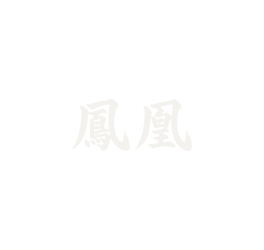
The hō-ō is the phoenix of Japan, a bird of virtue and good fortune said to appear only in times of peace. It crowns temple roofs, decorates the emperor’s robes and has been painted by some of the country’s greatest artists.
The characters: 鳳凰
Traditionally 鳳 is the male bird and 凰 the female, so the name joins the pair into one creature. Japanese uses a different word, 不死鳥, fushichō, the bird that does not die, for the Western phoenix that rises from its ashes.
Paulownia and phoenix
In Japan the phoenix is paired with the paulownia, the only tree it is said to rest in. The emperor’s robe for the most solemn court rites carries the two together, with bamboo and the kirin, and paulownia and phoenix appear across screens, lacquerware and textiles.
The Phoenix Hall
At Byōdō-in in Uji, near Kyoto, the Phoenix Hall was completed in 1053, with a pair of bronze phoenixes on its roof. The hall appears on Japan’s ten-yen coin, and one of its phoenixes appeared on the back of the ten-thousand-yen note issued in 2004.
Jakuchū and Hokusai
Itō Jakuchū painted the most celebrated Japanese phoenix, a white bird with lace-like feathers beneath an old pine. Katsushika Hokusai, at nearly ninety, painted a great phoenix across the ceiling of Ganshō-in temple in Obuse, its eyes following visitors in every direction.
The design
The Hō-ō design is an original drawing of the Japanese phoenix.